Which way does your elephant lean?

In my last post, with a bit of help from the Dulux dog, we considered the massive role our gut reactions and emotional connections play in our decision-making.

And what a useful tool they are! Imagine trying to make every decision you face in a day from an objective, factual and scientifically backed up standpoint. It would cripple us! We need our gut reactions to help us successfully navigate our way through our days well and safely. Not to mention with our own individuality in tact!

Useful? Undoubtedly! But also hugely, yet stealthily, powerful. Our emotions can give the impression of creeping cat-like through our lives and societies barely disturbing our carefully thought through, objective thinking; whereas in actual fact they stomp through our decisions and reactions like mighty elephants – as Glynn Harrison elucidates for us.

By the way if you are at all impressed by my use of elucidates please note that I stole it from the Disney film ‘Aristocats’! Let me know if you can tell me which bit.

Harrison points us to the work of social psychologists such as Jonathan Haidt and Daniel Kahneman who have gathered vast quantities of data illustrating how much of what passes as thoughtful evaluation actually operates at [this] subconscious gut level.

Haidt conjures the picture of a small man riding an elephant.

If the rider is our logical, rational, objective self, the elephant is our intuitive, instinctive self, our gut reactions, our visceral feelings about an issue.

Haidt gets us to understand our quick off the mark gut reaction as the elephant leaning. Inevitably, as a consequence, our logical self (the rider) ‘leans’ before he/she has actually reacted much at all. So he argues, “if you want to change someone’s mind you need to appeal to his or her emotional elephant as well as to the intellectual rider on top”.

Which means you need to know which way his or her elephant tends to lean!

Haidt has produced a convincing body of research to show that our intuitive reactions to moral questions tend to operate broadly along six basic psychological systems, or foundations. In laying out these six systems he helps us to identify the different points of view from which people evaluate a moral question. The main question that each of the six systems ask will differ – because different issues and concerns will take priority.

To give a very basic example let’s consider how different people might react when presented with a menu at a restaurant. When I look at a menu my first port of call is to identify which options are sugar-free, whereas the NTV is more likely to think: “what would I not have at home?” Someone on a very tight budget might look at price first, whereas anyone with an allergy will prioritise that. Some will always choose their main course first and let that determine the rest of the meal, others might be all about saving room for pudding.

So what are the central questions for Haidts six systems?
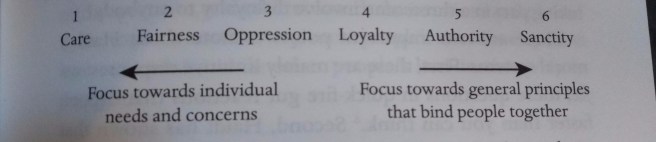
better story
Photo taken from page 29, A Better Story by Glynn Harrison, IVP 2016

When presented with a moral situation those one the left of the spectrum will primarily be concerned with the individuals involved. Are they safe? Are they being treated equally and fairly? In contrast, the factor linking the three systems on the right is a focus on general moral concerns and big principles binding people together. Are we meddling with a sacred principle here that could put the community at risk? What is the received wisdom on this within my community? Could I do this and remain loyal or would pursuing this weaken community cohesion?

And don’t forget that leaning elephant! These questions are being asked and answered on a largely intuitive basis. When we look at how we respond to the moral questions being asked in our nation at this time – we will start to identify whether our personal elephant has a tendency to lean towards the left or the right.

As I acknowledged in my last post I am a black and white thinker. This does not mean that I respond to everything objectively, without emotion – I am at the mercies of my gut reactions as much as the next person! It simply indicates the direction in which my emotions lean. I ride an elephant that leans to the right as exemplified by my strong emotional reaction to the new status quo settling in and getting its feet under the table seemingly without a carefully thought through logical debate.   

As a right leaner my concerns are as follows: Should we not give more consideration to tradition and past wisdom? Have we really thought about the effect on society in the future? Have we ever stopped to ask where the sexual revolution has got us?

In contrast, however, the general lean of our society is increasingly to the left of the spectrum. When faced with an individual who is suffering ‘society’ wants to make it better for them right there and then, on the ground, at their point of felt need. 

From my right-leaning perspective I evaluate what is happening in our society as an arrogant and presumptuous redefinition of what is right and wrong. I feel anger and incredulity at what is going on. What right do people have to ‘suddenly’ declare that 2 + 2 no longer equals 4?

What I have failed to see is that the whole nature of the question being answered has changed. As society collectivly leans towards the left it isn’t searching for a fixed answer to a fixed question. Rather, it starts with the individual ‘numbers’ involved and adds things up from there to discover what is best for the individual.

And so it is not simply the presence of disagreement that puts barriers in the way of loving fruitful conversation – but rather a totally different understanding of what we are disagreeing about. I can go on objecting until I am blue in the face – but I might as well be doing it in another language! To truly and lovingly engage with others in matters of human sexuality and gender, I need to stop simply telling people my answer to my questions, and start talking about the questions that concern those on the opposite end of the spectrum.

More on this to come no doubt – but to finish I just want to share a Note to Self that has arisen from all this:


Dear Self,
You have much to learn from those whose elephants lean left. You tend towards a lack of compassion towards the individual and a pride in correct thinking. How unlike my Saviour and Lord you are. Jesus always treated those he met as individuals and he always acted with compassion. Glorifying his Father, teaching truth and acting for the good of all never compromised his compassion or desire for the individual’s best. What perfect wisdom! 

Lord, help me to grow in my compassion, to value loving and serving people over promoting certain ideas for the sake of things being ‘right’. Thank you that there is no conflict between what is true and right and what is best. Lord please use me to lead people to your compassion and truth, to the one in whose name I pray now, Amen.  

Not so radical after all…Black and White Cats and Old English Sheep Dogs

The Minister’s Cat has now been with us for one year!

One of the things that constantly amazes me about him is the way in which he can appear out of nowhere as if by magic. One moment – not a whisker to be seen, then you look away for a split second and when you return your gaze there he is sprawled across the floor as if he had been there all along.

It’s the opposite with children isn’t it? They are sitting/lying there playing quite happily one moment and the next time you look they are nowhere in sight!

I think cultural ideas can be a bit like that – cats that is, not children.

I don’t want to negate or downplay the heartbreak and hard work of those who campaign for change, the years in which there is so little to show for their efforts. In the thick of it, ideas take forever to change and are fought for with blood, sweat and tears. To change the way a culture thinks, to re-set the accepted wisdom, the default position, ‘the way we do things around here’ is a painstakingly slow and a very costly process.

However, if we zoom out just a bit and look at things over the course of a century say – there are definitely moments when you return your briefly averted gaze to a particular spot only to find a radically different culture sitting there comfortably and proudly as if it had always occupied that exact spot and has no intention of moving until it jolly well feels like it.

What causes seemingly deep-seated beliefs of right and wrong to do a 180 degree flip over the course of a generation or two?

The quick answer? Because the way we decide what we like and what we don’t like has far more to do with our emotions, our immediate gut reactions that we tend to admit.

This was illustrated brilliantly for me by a Radio 4 discussion on paint brands.

Dr Robert Heath, Associate Professor of Advertising at the University of Bath School of Management, speaking on You and Yours, 27th Sept 2017 if you’re interested!

Apparently certain paint brands do significantly better than their (much cheaper) own brand equivalents not because they are technically superior, but because they have understood the role of emotion in our decision making. Basically, put an Old English Sheepdog on the tin and in the adverts and you get an emotional response that wins you loyal customers.

Dr Heath calls it subconscious seduction, stating: “Much of our decision making is based on our emotions and there is no question that devices like dogs are able to exert a very strong influence on our emotions at a subconscious level”. 

This is an important dynamic to understand when looking at how a culture changes – for example the massive shift in popular thought brought about by the sexual revolution.

Recognising this has has been a huge help to me as a black and white thinker.

If a long lost section of the bible had been discovered, if there had been some transparent, careful, well balanced analysis before we abandoned what has been accepted as God’s clear commands for centuries I would find it easier to engage. As it is I tend to bang my black and white drum about the clarity of scripture on the matter and tear my hair out at the lack of a chance to have a reasonable conversation about it.

As someone who is convinced that 2 + 2 still equals 4,  how should I engage in a universe in which it is 62 and proud of it?

My tendency is to simply mark society’s new maths with a big red x. Thankfully God has been using writers like Ed Shaw and Glynn Harrison to help me look behind the painfully wrong answer and to engage with the workings out.

Which is where the elephants come in – or rather where they will come in in due course.


A Better Story by Glynn Harrison

As you might have gathered I am slowly reading through:

A Better Story: God, Sex and Human Relationships.

In the same way in which he examines the history of the self-esteem movement in The Big Ego Trip; in A Better Story Glynn Harrison skillfully takes us through the promises, processes and stories of the sexual revolution.

This is not just a knee-jerk reaction against the rapidly changing world in which we find ourselves living. It is not a blushing attempt to squeeze everything back into the Victorian wardrobe it burst out of.

blogBursting closet

No. Instead, Harrison takes us though the story of sexuality and gender that the world has so wholeheartedly adopted and gives us the courage to ask – is ringing true or not? Has it delivered what it promised? Which of course then begs the question – if not, why aren’t we telling the world a better story?

Perhaps you feel happy that you are standing rock solid on the biblical truths you’ve always believed in?

This book will help you to take a careful look at the basis for that confidence. It takes the lid off our knee-jerk gut reactions (however correct they may be) and shows us just how beautiful those truths are. It will also help you understand what is going on around us and how to engage with others lovingly and to the glory of the Lord Jesus.

OR…

Perhaps you are unconvinced, or even frustrated and sickened, by the narrow stance some Christians are taking in this area?

This book is humbly and intelligently written and offers a great chance to have a rummage (or a ratch as we say up here!) through the issues past and present away from the constant noise of our own and other’s gut reactions.

Either way I couldn’t recommend it more highly!

But meanwhile, back at the beginning of the book…

I’m really excited by the super accessible way in which Glynn Harrison lays out for us the mechanics of idea forming and culture changing – inviting us as it were to take a look under the hood of society with someone who knows what he is looking at.

If you’re interested join me for my next post: Not so radical after all…Elephants and Old English Sheep Dogs

Prayer and Poetry

Gleaned from reading Morning and Evening – Devotions by Charles Spurgeon

Gracious Spirit dwell with me;
I myself would gracious be,
And with words that help and heal
would thy life in mine reveal,
and with actions bold and meek
would for Christ my Saviour speak.


Though thou slay me I will trust,
praise thou even from the dust,
prove, and tell it as I prove,
thine unutterable love.

Thou may chasten and correct,
but thou never can neglect;
since the ransom price is paid,
on thy love my hope is stayed.

Proclaim aloud the Saviour’s fame,
who bears the Breaker’s wond’rous name;
sweet name; and it becomes him well,
who breaks down earth, sin, death and hell.

Are we free to disagree?

Do you feel free to disagree with society’s current wisdom on marriage, sexuality, and gender?

Recent reactions to an ad campaign in Australia claiming that it is “OK to say “No” (in the referendum on same-sex marriage) would suggest that we are not free to disagree. That in a YES or NO referendum there is only one acceptable answer.

I can understand why those voting YES would react that way. If it is a case of turn taking it is certainly their turn to. The state, society and the church have not only declared for centuries that NO is the only answer, but have treated those who disagreed with contempt, violence, and punishment. I imagine that it is only within my lifetime that those who disagree with the traditionally held views of society and the church regarding sexuality have felt any freedom to express that disagreement at all.

Not only that, but as society and the church have increasingly parted company over the rights and wrongs of all sorts of lifestyle choices and a wide variety of beliefs – disagreement in the area of non-heterosexuality seems to have been isolated from and treated far more roughly than disagreement over appropriate sexual conduct within heterosexuality.

Basically, as both Glynn Harrison in his book: A Better Story and Ed Shaw (The Plausibility Problem) so helpfully point out – there are massive planks in our corporate (and individual) eyes that we need to acknowledge and remove.

But, keeping that in mind, the question remains: Are we free to disagree with the status quo? Are we free to disagree with the messages constantly promulgated and reinforced by the media? Are we free to disagree with the majority view?

Because I do.

I believe that God: Father, Son and Holy Spirit as revealed in the bible and ultimately in the God-man Jesus Christ, is our good and perfect creator God. I believe that he made us male and female, that he designed sex as part of that good creation to be enjoyed exclusively within a marriage between a man and a woman.

I am not saying, by the way, that a secular state is wrong in aiming to provide equal legal status for all couples that meet whatever criteria the state deems to be necessary. What I disagree with is the use of the term ‘marriage’ and the lack of freedom I have to express my disagreement.

I was at a civil marriage ceremony recently and as part of the ceremony the registrar gave the definition of marriage as currently held by the powers that be in that district. It made marriage seem like a rather movable feast.

The tables have turned. What was the majority view supported by the media, and by prominent figures in society is now whispered by a scared, secretive and at times ashamed minority. Society has not become more tolerant, it has simply changed who it is intolerant of. It is not an open, objective society that debates and converses in a balanced and fair manner. Would I be likely to appear on Woman’s Hour (as a bi-sexual couple were recently invited to do) to talk about how hard it is to gain an equal hearing in society? The microphone still rests in the hands of the majority, it is just a different majority.

As I said at the start – you can understand why you wouldn’t want to let go of that microphone. You’ve been shouted down (and worse) all your life and now the tables have turned.

So what are we – the minority – going to do?

We could just shrug our shoulders and disperse. Perhaps we’ve had our turn and botched it. Maybe we’ve lost our right to say anything. What if we’ve been wrong all along? Can we really claim to be right when everyone else disagrees? When what the bible teaches (if it really does teach that) seems so at odds with what the world wants to hear? When so-called biblical teaching has caused such pain? And when it comes to it are ‘WE’ really a ‘WE’ anyway? The whole idea that there is one right way seems so implausible now – in fact, now I think of it, I’ve never been that keen on it. Your reaction is so different to mine and The Church certainly isn’t keen to offer much in the way of leadership. Maybe we should just each work out our own way to proceed.  In this area at least we might as well disband and follow our own consciences.

But the thing is – I believe in the world’s desperate need to hear God’s word and to see it lived out in the lives of his followers. I am 100% convinced that God’s commands in every area of life are not only authoritative, but also good and beautiful and right. If those of us who call Jesus Lord don’t openly celebrate the goodness of those commands no one else is going to. Are we really going to sit in the corner while our nation is quietly robbed of all knowledge of the Christian worldview? I want my children to live in a country where they can hear and see Christians openly and lovingly disagreeing with mainstream thinking. I want to play whatever part I can to contribute to carving out a voice for those of us who believe biblical truths about human sexuality and gender. I want us to be free to disagree.

So let’s not shrug our shoulders and passively accept the gag that is slowly tightening around our mouths. According to the law (currently at least) we are free to disagree. Let’s exercise that freedom.

In case you are worried – I’ll say it again – whatever we do we need to be honest about past mistakes, and we need to act in a way that is above reproach, dripping with gentleness and humility. We also need to keep the main thing the main thing. Our job is not to force our nation, or individuals into submission to God’s rules about sex. For many years – until relatively recently – our nation has been full of people towing the line – in public at least – regarding traditional teaching on sexuality and morality more generally. Sadly it has not been full of people hearing God’s just verdict on sin, or even being taught what sin is. It has not been full of people hearing of God’s costly love for sinners, of his grace and kindness to us in sending his Son Jesus to die and rise again for us – freeing those who put their trust in him to walk in God’s good ways and to look forward to eternal life when the battle with sin will be over. It has not been full of people sharing their struggles and helping each other walk more faithfully with the Lord.

Let me repeat myself – we need to keep the main thing the main thing. Our job is not to force our nation, or individuals into submission to God’s rules about sex. Our job is to go into the world to make disciples, “baptising them in the name of the Father and of the Son and of the Holy Spirit, teaching them to observe all that [Jesus has] commanded [us]”.

Caring about our freedom to disagree with and present an alternative to current mainstream thinking is just part of living authentically and publicly as Jesus followers. But it is a part that is currently under threat. How can we sit in our churches reciting hallowed be your name every week and yet do nothing to show that the Lord’s name is hallowed in our lives? How can we pray hallowed be your name and yet not long for it to hallowed all over the world – that he might be glorified and the whole world blessed by his loving and good rule?

Well my blogging morning is way past over and it’s time for me to sign off. If this post has caused any sort of reaction in you please do comment; and if you haven’t already please consider reading Ed Shaw’s book -The Plausibility Problem; and Glynn Harrison’s book: A Better Story. They both have far more right and are far better qualified to teach on this issue than I do/am. But let’s not leave it all up to the experts, and those on the front line. Surely we can all ask: Am I free to disagree?

#amifreetodisagree

No doubt I’ll return to this as I read and think more, but for now hear the concluding words of our loving saviour to his disciples as he commissioned them and be encouraged:

“And behold, I am with you always, to the end of the age”.

Knowing the incomprehensible. When is a mystery really a mystery?

We pictured in my last post a mountain path boasting an amazing view. We considered that while we can’t know God as a scientist might know the specimen under his scalpel, or his microscope; we can know him in the sense of having an intimate relationship with him and having the eyes of our hearts increasingly opened to see and treasure what he has shown us of himself.

I believe that God has made himself clearly known to his children. I believe that we can gaze with understanding and clarity on that which is beyond our comprehension.

For example: Is the doctrine of the trinity a mystery? In one sense – yes. Of course it is! I can’t take it apart and lay it on the table to show you how it works (even if I wanted to). However, the fact of the Trinity is not a mystery to me. Whether or not God is one God in three persons is not a mystery to me. It has been clearly revealed to me. By God’s grace, I have come to understand that God is indeed one God in three persons through the revelation of the Holy Spirit as I have read God’s word and as I have been taught faithfully from that word by his saints. Can I grow in my understanding? Of course – Christians are life long learners. Is there a limit to my comprehension? Of course – I am his creation, he is my creator. But alongside all of that I can get on with experiencing the love lavished on me by Father, Son and Holy Spirit and worshipping the only true God in spirit and in truth in the light of his clear revelation of his nature as one God in three persons.

Let’s consider this: What makes something a mystery? What do we tend to refer to as a mystery?

Of course there are the inevitable questions regarding socks: How do they end up all over the house and where they go when you put them in the wash? On a more theoretical level I would certainly have to label the likes of quantum physics and pure maths as mysteries to me.

But are we saying that unless you possess a comprehensive knowledge of someone or something we should declare him / her / it a mystery to us? I don’t think so. My car, for example, is not a mystery to me. I am no mechanic (I not even 100% confident refilling the screen wash!) – but I do know that my car is the thing that gets me from A to B (on a good day!). I know how to drive it, how to fill it with fuel and most of the time I can even spot which one is mine in the multi-storey! Does it contain things that are beyond me? Yes. But do I refer to it and relate to it as mystery to me in daily life? No.

So basically what I am encouraging us to do is to celebrate having the best of both worlds!

We can worship the holy, other than us, utterly beyond us, God-ness of God in the full light of his clear revelation of himself. We neither have to squeeze him into a box compatible with our finite minds, nor do we need to shrug our shoulders and each go our separate ways into a fog of ignorance or imagination.

What a generous, loving, amazing God we worship!

Thank you so much Father for showing us what you are like and giving us all that we need to properly receive your revelation. I praise you that you are both wonderfully and infinitely beyond us AND (in Jesus) intimately related and revealed to us.

You are worthy of all of our worship, all our love and obedience; you are worthy of our all.

Unite your people Lord. Strengthen us, convict us and give us courage. As our nation rejects the very idea of authoritative truth – help us to boldly proclaim you as you have revealed yourself to us. As we live in a society that has rejected your ways and vilifies those who walk in them – help us to faithfully and proudly* live as you have commanded us. I ask this in Jesus name. Amen.

*Proudly? Is that right? More on that later! 

Things beyond my ken

First things first: Does anyone else recognise the above title as a quote from The Sound of Music?

Secondly – and rather more importantly – I would like to share with you some quotes not from Rodgers and Hammerstein but from Charles Spurgeon’s ‘Morning and Evening’ devotional (evening reading for September 5th).

“Some things in nature remain a mystery even to the most intelligent and enterprising investigators. …Universal knowledge is for God alone. If this is true in the things that are seen and temporal, I can be certain that it is even more so in the spiritual and eternal matters.”

Spurgeon goes on to berate himself for “torturing his brain” with speculations on truths that while stated clearly in Scripture for us to believe and enjoy and submit to are beyond our ability to understand, take apart and then put back together.

“Do not let me strive to understand the infinite, but spend my strength in love. What I cannot gain by intellect I can possess by affection, and that should be enough for me. I cannot penetrate the heart of the sea, but I can enjoy the healthy breezes that sweep across it….The simplest act of obedience to Him is better than the profoundest knowledge.”

It seems we need to avoid two errors.

Firstly: We need to make sure we don’t shrink from the breathtaking views of God’s awesome, mighty, majestic nature that he gives us in his word. Let’s not avert our gaze from his glorious plans for glorifying his Son and all that he intends for the people he has given him. Let’s go right to the edge of the mountainside as it were and breathe deeply of these truths and feast our eyes on the view they give us that we might live obediently and joyfully in the light of them.

And secondly: Don’t fall off the edge! Don’t get lost in speculation or get distracted and frustrated by a desperate need to have it all worked out. Amazingly we know what God wants us to know:

His divine power has given us everything we need for a godly life through our knowledge of him who called us by his own glory and goodness.   2 Peter 1:3

We can know God! Not as a scientist knows the rat he is dissecting, but as a child knows his father. When Paul writes of knowing God in 2 Timothy 1:12 he isn’t boasting of an A* in a recent theological assessment. No! Paul is delighting in who he knows – resting in a knowledge that leads to trust and perseverance.

As we continually read the whole counsel of God we will know God better – not because we are examining him ever more thoroughly, but because we are revelling in all that he wants us see and experience of him.

Bonjour and other bits and pieces

Greetings from a cafe in France. Supper – if not in the slow cooker – is slow cooking in the oven where I am staying and here I am on my own with a lovely coffee and a delicious spread of scrappy notes to peruse at my leisure and if they still make any sense to me – to share with you.

I’m sure you’re not – but just in case any of you are worried that this is breaching the ‘just being’ plan [- see previous post] please don’t be. Simply driving up here in our borrowed* automatic car and leaving behind my slightly guilty feelings for ‘needing’ to nourish myself this way has been a brave exercise in self-awareness and self-acceptance – dare I even say celebration of who God has made me to be? – and I am certainly intending to be in this moment and to enjoy it without any strings attached. I could almost hear the strings snap as I (or rather the automatic car) drove away.

*The borrowed car not only keeps going very reliably – a novelty for us recently – but is also a wonderful prompt to praise the Lord Jesus for his provision through his church. Our dear friends have lent us their car for our whole holiday to save us from our own very trying and sometimes giving up set of wheels. We thank God for you!

So to bits and pieces…or (if I can rely on google to get the translation correct given the context) les petits bouts or les petits morceaux….

The Missing Piece:

As I have mentioned before I am slowly working my way through The Heidelberg Catechism. Early on there is a question about the three things necessary to know “that in comfort you may live and die happily”.

I was struck that we are quite clear and ‘good’ with the first two.

  1. To know the greatness of my sin and misery.
  2. To know how I am redeemed from all my sin and misery.

Generally speaking, the first two truths are covered well in our various courses, within our teaching programmes and service structures….but what of the third?

What would you put next?

I’ll give you a clue:

3. How I am to be ___________________________ to God for such redemption.

I would argue that this third vital bit of knowledge – this precious knowledge necessary to “living and dying happily; in comfort”- gets rather short-changed in our prayers, conversations, contemplations and courses.

But why? Well – perhaps because it is not something that we can simply teach or cover as such. “How I am to be thankful to God for such redemption” isn’t exactly something you can instruct people in is it?

BUT, by the work of God’s Holy Spirit, by his transforming grace it is something we can live out and exemplify and it is something we can ask our gracious, redeeming God to reveal to the hard hearts of those we teach and witness to. It is something we can see the lack of and pray for God to cause to spring up in people’s lives.

Lord please help me to be daily and breathlessly thankful to you for “such a redemption”. Please kindle and fan into flame such thankfulness in my children. I long for them to “in comfort, live and die happily”. Please provide them with excellent, engaging, faithful teaching from your word about their great sin and misery, about redemption in Christ AND teach them please Lord, in your mercy, how to be thankful for such a redemption.

How to stir without shaking

Do you ever feel that by opening up tricky doctrines, by covering parts of scripture that have previously been left undisturbed, you are making life more difficult for those you are ministering to? Do you ever hesitate before stirring up everything that seems so still and calm, muddying the waters that on the surface appear so clear?

Our basic aim in instructing and correcting is to give clarity. Perhaps we can develop a vague idea into something more concrete, pointing out the clarity that scripture offers. If we need to reveal error it is often in the context of offering crystal clear truth in its place. But when it comes to challenging wrong thinking about free will and predestination or opening up what the bible has to say about the origin of evil, or casting doubts on cherished ideas about what heaven is like – it can feel less like instruction and more like pickpocketing. In a cunning sleight of hand we pilfer their serviceable clarity and replace it with an unfathomable mystery!

In trying to undo the knots are we in danger of unravelling the whole thing? Are we making things harder for those we are seeking to help?

Well to a certain extent yes – but just because it may be hard, frustrating and even painful doesn’t mean it is harmful or wrong. It is possible to stir without shaking!

Until relatively recently a regular part of my life was taking The Court Jester to speech therapy. Due to hearing problems as a baby and tonsils that were not only ridiculously large, but too far forward in his mouth he had to go through the difficult process of ‘un-learning’ certain speech sounds and then retraining his brain to make the sounds correctly. Was it hard work – yes! What comes naturally to almost everyone else is still a process of conscious correction for him. But were we simply over complicating things for him? Were we muddying the waters? No – the waters were already muddy – the problem was that his brain didn’t realise it. And so he had to overrule his natural instincts and submit to the clumsy process of rebuilding each sound from a set of rather awkward building blocks. We went right into the technicalities of each sound not to over intellectualise speech, but to enable its healthy development. And the result? Well, for a long time (and in some cases to this day) the corrected sound was less confident, less immediate and less smooth than the wrong sound – but it was correct and gradually the real clarity is coming.

In the same way, as we teach and learn alongside our fellow believers we shouldn’t fear lovingly and humbly stirring things up as we delve into the whole counsel of God. We shouldn’t avoid what is tricky or unfathomable. While it will be hard to abandon what has always come naturally to us, what has rolled off our tongues without us having to think about it – it will be worth it because we will know God better. While we may feel certain of less, we will be led deeper into his truth and therefore into a closer relationship with him. A correct lack of clarity within God’s revealed truth is far better than crystal clear error outside of it.

Please don’t misunderstand me. I am not talking about using big, obscure words where simple, clear ones will do just as well. I am not talking about taking the focus off the saving work of the Lord Jesus in order to pour over obscure questions that the text was never intended to raise (see Paul’s command to Timothy in chapter 1 of his first letter to him!).

But let’s not cower under false accusations of over intellectualising faith and making things more complicated for the sake of it. The idea of a simple faith sounds so spiritual, but what if it is being used as an excuse for error and laziness? Yes, Jesus tells us to enter the Kingdom of God like little children, but beware of immaturity impersonating child likeness. Look out for a lack of appetite for spiritual meat, a tendency to spit out anything that requires chewing over!

The amazing truth is that God has revealed himself so clearly to us in his word and in his Son. Thanks to the work of the Holy Spirit in us and through his word the gospel is crystal clear! God’s goodness is crystal clear, as is his might, his love, his justice, his purposes and his right to all the glory and praise and obedience and adoration. With this clarity as our anchor and air supply we can dive into the depths of God’s revealed truth with a sense of excitement and delight. We can be stirred up without being shaken. And the more we dive, and the deeper we go the clearer the character and purposes of God become.

Well, hardly the multiple bits and pieces I was aiming at! More like a couple of crumbs – rather like the pieces the NTV and I are offered when the children ‘share’ their treats with us! Not only that, but it is over 2 weeks since I started this post and I am far away from my cafe in France, term has started and I am back in one of my regular spots running late for lunch and desperately needing the loo. And so I will have to leave you with just one bit and a tiny piece and hopefully an appetite for a crumb or two more next week.    

Summer Stillness

As has been obvious from the absence of posts over the last few weeks, the summer holidays are upon us and my weekly writing slot has been hijacked. Room re-arranging, packing, lifts to camp and enjoying the Keswick Convention have left me little time for routines and regulars.

While I am hoping to get some delicious writing time over the next few weeks I am also trying to challenge my default mindset that proudly whips out a ridiculously long and over ambitious list of things to get done over the holidays before I’ve even folded up the final piece of school uniform.

“Look at all these restful, productive, satisfying things I’ve got planned for you to accomplish!” the mindset says; beaming. It’s like a dog looking for praise having retrieved something that you would rather had remained buried. “You could complete and publish all your draft blog posts, collate all the scraps of paper with scribbles ideas on them, write a talk series, develop a resource to help families get talking about certain things, actually do those two other projects that have been gathering dust – literally and metaphorically – over the last 6 months and read 5 books….. – oh and by the way – aren’t I clever to have got all that ready for you?”


“Clever? Possibly. But helpful? Not so much – sorry!” I say, trying to break the news gently. “Could you maybe take the list away and go and dig up some stillness for me instead?”

Stillness – well that’s a whole other blog post – and one that I look forward to writing. It is a concept that I naturally react strongly against. An antipathy due partly to a legitimate suspicion aroused by poor handling and application of verses like Psalm 46:10, but also, as I am very slowly, but helpfully learning, because I’m just really bad at it!

But more of that another time. Now is a season in which to actually have a go at more being than doing.

For now I’m going to pretend that I don’t dislike like that phrase as much as I do the idea of being still!

So while I am feeling excited about the possibility of sitting in a French cafe blogging, I also feel excited by the awareness that it is just that – a possibility. A particularly toothsome one – yes – but a possibility none-the-less without a pressure or a list in sight. Until, that is, my default mindset comes panting up with one in its mouth!

Routines and regulars will return in September; as will a roughly weekly blog post from me. But for the next few weeks – well I’ll just see where they take me and what it is like to be there.

Dear Father, help me to explore stillness and quietude in a godly, discerning way that is also brave and persevering in the face of a highly trained habit of busy. In Jesus’ precious name, Amen.

Born Again

The need to be born again in order to see the kingdom of God (John 3) is hardly an unfamiliar concept. Sadly it has been misused to describe a certain type of Christian, and perhaps because of that avoided slightly as a general term we use when talking about our faith. Having said that – phrases like ‘new birth’ and ‘dying to our old selves’ are regularly used to describe what happens when a person comes to faith in Jesus.

I mention the phrase now simply because I have recently had another layer, or facet of the potency of the concept exposed to me recently.

As I have mentioned I am slowly working through The Heidelberg Catechism. After the Introduction the first part of the catechism (questions 3-11) is entitled quite simply: Guilt.

The Introduction is amazing starting with the question: What is your only comfort in life and in death? Question 2 goes on to ask: How many things are necessary for you to know, that in this comfort you may live and die happily? The answer is 3. First the greatness of our sin and misery. Second, how I am redeemed from all my sins and misery. Third, how I am to be thankful to God for such redemption.

Point three has also really got under my skin, but that is for another post.

Questions 3-11 then unpack the guilt and misery of our condition as humans. Having summed up what the Law of God requires of us it asks us in Q5: Can you keep all this perfectly? And the answer? No, for I am prone by nature to hate God and my neighbour. It goes on to ask if we were created that way – answer in short – NO! So where does it come from? From the fall and disobedience of our first parents, Adam and Eve in Paradise, whereby our nature became so corrupt that we are all conceived and born in sin.

Then Q8 comes: But are we so depraved that we are completely incapable of any good and prone to all evil?

And the answer?

Yes, unless we are born again by the Spirit of God.

In Q9 the question is posed: “Does not God, then, do injustice to man by requiring of him in His Law that which he cannot perform?”

And the answer shines a spot light on our desperate need to be born all over again into a very different family.

“No, for God so made man that he could perform it; but man, through the instigation of the devil, by wilful disobedience deprived himself and all his descendants of this power.”

Wow – huge, mind-expanding, heart-stretching truths are swirling around right now!

It isn’t that any of this was a huge intellectual or theological surprise to me.

Although we do tend to shrink things to something a bit more manageable and palatable don’t we? Something that is just a bit easier to serve up in our bible studies and our one-to-ones. 

Simply reading through questions 1-11 didn’t particularly ignite much thought or emotion in me.

BUT as I read and re-read and committed these statements to memory (or tried to!) – in other words as I meditated on the Scriptural truths presented – the sheer hopelessness and helplessness of the human race when left to its own devices hit me right between the eyes of my heart.

Of course I needed to be born again! It was my only hope.

[Note the Star Wars reference!]

From the moment I was conceived the most important thing that needed to happen to me was to go through the most radical and thorough ‘start all over again’ possible.

I say possible – but how can it be possible?

Nicodemus asks exactly that – but he asks because he is trying to picture himself literally re-entering his mother’s womb. Impossible – yes.

[As a mother I am crossing my legs at the thought!]

But also completely useless. Our helpless situation is a problem of inheritance. To be born again into the same race, into Adam’s helpless race, would be of no use at all. Our second birth needs to be quite different from our first!

And still Nicodemus asks “How can this be?” – and I am assuming that as I go on to ‘Second Part: Grace’ in the Heidelberg Catechism I will have many chances to revel in the answer to that question. But I am so glad that first I have been plunged into the depths of our depravity and culpability. The futile, foolish, heartbreaking situation we are born into. How much brighter the grace of God will shine, and how much more deeply will the miracle of my new birth grip me. For not only do I need to know “how I am to be redeemed from all my sins and misery”, but also “how to be thankful to God for such redemption”.

Thank you my gracious, wonderful, miracle performing Father. Thank you for giving me new birth, not a re-birth that simply takes me back to the start of the same old story, still heading towards the terrifying ending, but a completely new birth into a totally different story, the story of your Son. The story that has no beginning and no end! The story that just gets better and better and better. Thank you, thank you, thank you. Amen.