So what exactly does God expect of mothers?

AAEAAQAAAAAAAAQmAAAAJDU5M2IxN2Q1LTMwYjAtNDQ1YS04YzFiLWZkNGViYmNmMDIzZA
Soaring not Striving

Please forgive the rather long adjournment – not the brief recess you were promised by any means! In my defence I was resting – see last post!

Anyway I’m back now so we can continue with our rather haphazard, whistle-stop tour of what God expects of us mums (and indeed what he doesn’t expect of us) and what we can anticipate family life being like.  


6. God often works through and in families. They are a God-given dynamic within the church and society.  This is not to say that family is the only dynamic. God indeed has no grandchildren and many of his children are ‘not of this flock’; but it is clear from his dealings with Israel (the inheritance of the land, the exhortations to teach the LORD’s commands to their children, to speak of what he has done) as well as the saving of households in the New Testament that he often works through and in families. I can’t claim to understand all the references to this – but they are there e.g. 1 Corinthians 7:14

7. Passing on the good news to future generations can get easily pushed out. Life generally and family life itself can become an idol, and/or a distraction from celebrating the Lord’s goodness and serving him wholeheartedly. In Deuteronomy Moses warns the people of the danger of forgetfullness as they settle into the land and have children and then grandchildren:

“Only be careful, and watch yourselves closely so that you do not forget the things your eyes have seen or let them fade from your heart as long as you live. Teach them to your children and to their children after them.”  Deuteronomy 4:9

8. My primary identity is as a child of God, not as my children’s mother; and as a member of a church my children are not limited to my biological children. In the New Testament many of references to children and family are referring to God’s children and to the church.  It may even be that we are called to ‘leave’ our children for the sake of the gospel: Luke 18:29 

9. It is right and natural for us to be compassionate and kind to our children though we are evil. The love of parents for their children is a common grace, but as sinners it is also something we need to be taught. Psalm 103:13; Luke 11:11-13; Titus 2:4. Broken relationships between parents and children, children rebelling against their parents point to a serious departure from God’s good ways: Malachi 4:6, Romans 1:30

10. Discipline is a right / natural part of parenthood. Proverbs 13:24; Hebrews 12:11

11. Proverbs also exhorts us to be an example to our children and to teach them wisdom – both in the early father and son chapters, and also in specific proverbs:

“The righteous lead blameless lives; blessed are their children after them.” (Proverbs 20:7) Start children off on the way they should go, and even when they are old they will not turn from it. (Proverbs 22:6)

But we need to remember the nature of wisdom literature and not make individual proverbs into golden rules and mathematical equations. They don’t guarantee a certain result from a certain action, but give us a sense of the life lived following God’s good ways.  After all Proverbs 30:11 warns us: “There are those who curse their fathers and do not bless their mothers” !!

12. God knows what it is like to be a parent. He knows both what it is to have rebellious children – us lot; and also what it is to see his Son suffer.

13. We are not to hinder children from coming to Jesus.  Luke 18:15-17

14. We are not responsible for our children’s’ eternal destinies. As Ephesians 2 reminds us:

4 But because of his great love for us, God, who is rich in mercy, 5 made us alive with Christ even when we were dead in transgressions – it is by grace you have been saved. 6 And God raised us up with Christ and seated us with him in the heavenly realms in Christ Jesus, 7 in order that in the coming ages he might show the incomparable riches of his grace, expressed in his kindness to us in Christ Jesus. 8 For it is by grace you have been saved, through faith – and this is not from yourselves, it is the gift of God – 9 not by works, so that no one can boast. 10 For we are God’s handiwork, created in Christ Jesus to do good works, which God prepared in advance for us to do.

BUT GOD: thanks to his great love and mercy God can bring our children from death to life. That job has been taken – so don’t apply for it!

Peter replied, ‘Repent and be baptised, every one of you, in the name of Jesus Christ for the forgiveness of your sins. And you will receive the gift of the Holy Spirit. The promise is for you and your children and for all who are far off – for all whom the Lord our God will call.’ Acts 2: 38-39 

We have good news and it is there for our children too. Let’s make sure they hear the promise, but it is for the Lord to call them.

And as an aside: God does not love us mothers because we work hard at our parenting. Not only will the quality of our parenting not factor in our children’s standing before God, but neither will it factor in how God views us. While being a Mum is a huge part of the good works God has prepared for me to do – at least for today – how well or badly I think I am doing those works doesn’t change God’s love for me one jot.   

15. A potential pastor’s family does reflect his suitability for ministry. See Paul’s commands to Titus and Timothy.

16. Fathers are commanded to bring up their children in the training and instruction of the Lord and to avoid embittering and exasperating them*. Ephesians 6:2

17. 1 Timothy 5:10 tells us that bringing up children is a good deed!

18. It is appropriate for parents to provide for their children: 2 Corinthians 12:14; and then for children to look after their elderly parents: 1 Timothy 5:4

GettyImages-171116205* I’m wondering if Paul had spent much time with teenage girls – I don’t seem to be able to walk into a room without exasperating my daughter at the moment. Perhaps it is an intentional/thoughtless exasperating we are meant to avoid?


So there we are – far from a complete overview – but I’ll attempt a summation next time! Do let me know of any omissions that need to be included!


Basking, asking, but not tasking…

AAEAAQAAAAAAAAQmAAAAJDU5M2IxN2Q1LTMwYjAtNDQ1YS04YzFiLWZkNGViYmNmMDIzZA
Soaring not Striving

What would my week look like if I planned into it a day without tasks? Of course the obvious reply is: “Define tasks”

28489392_s

Well here are some tasks that are relatively simple to plan not to do on a particular day.

nottodo

  1. Washing – certainly not load after load.
  2. Accounting tasks
  3. Batch cooking
  4. Shopping for birthday presents, and weekly supplies
  5. Going to the tip
  6. Preparing bible studies or Sunday School
  7. Cleaning the sinks……..

There are of course certain things that always need to be done, day in day out.
For example: Some form of feeding people; hanging out the school uniforms because they need to be dry by Sunday evening; cleaning up a spillage…

Or to use Jesus’ example: rescuing an ox that has fallen down a well.

The trick is to spot the difference coming upon a struggling ox (not something I can say has ever happened to me!) and doing what you can to help (not sure I would be of much use!) and scheduling yet another full day animal care into your week.

Get creative – or perhaps I should say less creative! Things that do have to happen daily can be simplified. Food can come out of the freezer or a jar or be prepared with someone you love in a way that is distinctive to that day as compared to the daily grind.

Which gets us to the crunch I think – how can we make a day distinctive and spacious? A day where the focus has shifted from getting things done and under control and subdued and all within a limited time frame, to enjoying, and resting and basking in the Lord’s goodness. A day of basking, of asking the Lord for help and instruction and refreshment, and not of tasking.

I realise I am opening a can of worms here – one that I am not qualified to tackle! I can’t really take you through a detailed theology of the Sabbath. I do know that there is a lot to explore around the subject! For example: How rest features in the creation account, the unending 7th day of rest, the Hebrew 3-4 idea of entering God’s rest and then the idea of looking forward to the day when Jesus calls us into his new creation to enter his rest. Jesus’ treatment of the commands re the Sabbath in comparison to the way he reiterates and handles the other 9, not to mention his regular challenging of the way it had wrongly become a rule fuelled rod to beat people with….

can of wormsAnd yet, can of worms wriggling away to one side, would we be wise to take a day of rest? To feast on the Lord, and stop trying to run things for a few hours? I think the answer is probably yes. So what needs to go from my weekly/monthly/yearly lists to make room for some of those not to-dos to get done on other days – well that’s another can of worms!

As God is my witness

AAEAAQAAAAAAAAQmAAAAJDU5M2IxN2Q1LTMwYjAtNDQ1YS04YzFiLWZkNGViYmNmMDIzZA
Soaring not Striving

A note of introduction to this testimony: Please forgive this very patchy, poorly put together attempt at summarising what God’s word says on the huge topic of parenting. For a proper look at the subject please refer to the many more thorough resources that I am sure are out there! Having said that I hope this summary will serve its purpose in the context of this series of posts: that is to start to see what God’s word really does have to say to mothers, and what it really does ask of us in contrast to the many and varied extrapolations that make their way to us via parenting books, sermons, blogs etc.

Witness 6: God’s word concerning children and mothers

1: All of motherhood and family life is happening in a post-Genesis 3 world. Motherhood will be difficult and frustrating: from giving birth, to doing relationships and pressing on through the logistics of life.  The narrative surrounding Jacob’s family is a good example of this (not to mention Cain and Abel!).

2: Motherhood is one of God’s gifts – he is sovereign over who is born to whom and when.

3: Celebrate God and his rescue in such a way that prompts questions from your children and be ready to amaze them with God*.

Exodus 12: 25 When you enter the land that the Lord will give you as he promised, observe this ceremony. 26 And when your children ask you, ‘What does this ceremony mean to you?’ 27 then tell them, ‘It is the Passover sacrifice to the Lord, who passed over the houses of the Israelites in Egypt and spared our homes when he struck down the Egyptians.’”

1 Peter 3:15 But in your hearts revere Christ as Lord. Always be prepared to give an answer to everyone who asks you to give the reason for the hope that you have. But do this with gentleness and respect.. 

4. Our choices / sin / godliness as parents do have consequences for future generations – Exodus 20:5; similarly there are consequences to children’s obedience / disobedience – Ex 20:12.

5. The consequences of our sin / godliness and the choices of our children do not thwart or change God’s good and perfect will.

Psalm 115:3: Our God is in heaven; he does whatever pleases him.

Due to the extensive nature of the testimony from this witness court will adjourn for a brief recess.


* A thread to follow in due course: Old Testament believers had specific scripts for certain meals and celebrations, and specific instructions regarding physical reminders of what God had done. Do we have particular commands along these lines as parents and church communities today? In what sense is the Lord’s supper meant to be experienced in this way? In coming up with ideas to carry the principle of distinct, conversation prompting patterns from the Old Testament to our families and churches today are we in danger of adding yet another item to put in the bag labelled: Things that I probably haven’t done well enough – otherwise our family would be happier and more in love with Jesus.

Any thoughts??????

Next witness please…

AAEAAQAAAAAAAAQmAAAAJDU5M2IxN2Q1LTMwYjAtNDQ1YS04YzFiLWZkNGViYmNmMDIzZA
Soaring not Striving

Witness 5: The people who write books and give talks on Christian parenting

Parenting
Intention to be intentional: 9 / 10
Actually consistently doing ‘it’: 5 / 10
Reading the bible with her daughter since she started secondary school: 2 / 10
Reading the bible with her daughter when she was younger: 7 / 10
Discipling her children in their prayer life and bible reading as they grow up: 5 / 10
Applying God’s word in discipline: 6 / 10
Being patient, merciful, and modelling grace and humility: 6 / 10
Speaking and living the gospel of grace with her children: 8 / 10
Teaching discernment and wisdom by intentionally chatting about life: 3 / 10
Giving her children opportunities to be discipled by others: 4 / 10
Amazing her children with God vs exasperating them: She dreads to think.
Planning to thoughtfully pray for her children and about her role as a Mum: 8 / 10
Actually, consistently praying for her children and about her role as a Mum: 4 / 10

Attitudes and reactions to parenting
Trusting all this to God: 3 / 10 Although she does know that the answer is Jesus!
Steering clear of having a: “Put this stuff into your kids and get a great Christian adult out” mentality: 8 / 10 But only because she knows the answer is Jesus!
Trusting God’s will for her life and the lives of her children: Read on! 
Not being crushed, petrified and paralysed by every roll of the eyes, every harrumph, each sarcastic remark, the disobedience, the arguments and bickering: 1 / 10
Not counting every sin, mistake, or failure in her family as her own: 1 / 10
Understanding the difference between carrying a burden that isn’t hers and faithfulness to her role: 1 / 10

Conclusion: This woman desperately wants to be a great Mum. She understands that the best thing she can give her children are opportunities to see and follow Jesus. There is, of course, more she could do to do this well and to develop new patterns as her children get older. BUT we are very worried about where her identity is and where her hope for her children lies.

Spoiler alert! The answer is grace

AAEAAQAAAAAAAAQmAAAAJDU5M2IxN2Q1LTMwYjAtNDQ1YS04YzFiLWZkNGViYmNmMDIzZA
Soaring not Striving

Just to reassure any concerned readers – I do know that the answer is, as always…


JESUS

So why the court case*?

Because I believe that God wants me to experience his grace and display his grace and not just know the theory.

How can I underpin my parenting, and indeed my everything, with grace and not just put a big red rubber GRACE stamp over the case file?

Irony alert: I am also aware how dangerously close I get to berating myself on my poor grasp of grace, and urging myself to work harder at doing grace better.

Getty_irony-556724397-56a3cb205f9b58b7d0d3cbea

How can I underpin my parenting, and indeed my everything, with grace and not just put a big red rubber GRACE stamp over the case file?   

Lord please teach me to drink deeply of your grace, not only in my parenting, but in the face of my blatantly frail grasp of your grace!

* See my previous post: Crushed by Motherhood

Crushed by Motherhood

europe-got-crushed-today

Most of you will know that I have had four children. My second child was stillborn and is with the Lord. The other three – now 13, 10 and 8 – are still in my safekeeping.

 
Safekeeping – are they really in MY safekeeping and if so how safe is that?

Am I a good or a bad mother? Let’s find out.

Witness 1: The children

I’m so sorry…there seems to be some sort of a problem….

O.K. It seems these witnesses have been discredited as their answers changed from “She’s the best Mum in the world” to “She hates me and wants to kill me and ruin my life” and back again in the course of a few hours.

Witness 2: The State

Attendance at school: Pretty good – but there was that unauthorised absence and they did keep them home when they were ill so they failed to get their 100% attendance certificate.
5 a day: Not bad
No more than two ‘100 calorie snacks’ per day: Fail
Exercise: Just about acceptable

Overall assessment: Could do better, but then she doesn’t require any intervention from us so that’s good!

Witness 3: The Professionals

Excellent. Developmental checks and medical appointments are attended. Children are adequately cared for and know they are loved.

We do have concerns about radicalisation and indoctrination with fundamentalist Christian beliefs, but that does not come into our current remit.  

Witness 4: Middle Class Society

Breastfed until a year: Almost. Score: 9 out of 10
Baby-led weaning: Exempt – before her time
Washable nappies: Tried, but failed. 1 / 10
Routine: Gina Ford: 8 / 10. No – sorry scratch that from the records – apparently  that’s bad. 0 / 10 should have just gone with the flow. All that controlled crying has scarred them for life.
Current nutrition: O.K. Makes spelt bread for her wheat intolerant son. Allows lots of snacks. There are quite a few things they won’t eat – including anything green and leafy, sweet potato and tofu. Only manage 50/50 bread and sometimes balk at crusts. Have chips and frozen stuff (fish fingers, nuggets, pizza) once a week. Generally prepares non-processed food from scratch.  6 / 10.
Participation in extra-curricula classes: Not bad at first with the first one and then downhill from there. Currently: No sports clubs or martial arts, only 1 instrument (not one each, just one!), minimal participation in uniformed organisations, dance and drama. Never had swimming lessons and only 2 can ride a bike – just.  Never been skiing. 3 / 10
Culture: Encourages reading, but very few museums and galleries. Cinema chosen over theatre. 5 / 10
Education: Listened to Mozart while pregnant with number 1. Used Baby Einstein DVDs and did baby signing with first two. Supported early reading. No tutoring or extra languages. Drives to a non-catchment school. Didn’t go down the grammar school or scholarship route – but hard given location. Doesn’t read through all their homework or drill them for tests.  Tries hard – 6 / 10.
Overall score: 6 / 10

Court adjourned. There will be a brief recess before further witnesses are called.

Definitely time for a coffee!

It’s written all over her face!

Will a heart rejoicing in the LORD show in our faces?

I think so.

Please don’t misunderstand me. I’m NOT talking about putting on a mask over our sadness, our depression or just the every-day-ness of a rainy Wednesday in December. I’m not talking about painting on an inane grin like a clown putting on his makeup.

In my last post I mentioned that my children’s regular enquiries about what was wrong had given me pause for thought.

Why? Well it wasn’t because I fear them seeing me weak or low. I was not annoyed with myself for failing to hide my feelings. It isn’t that I want them to always see me laughing and happy rather than sad and full of sorrow.

Which is just as well because I tend to wear my heart on my sleeve.

If this is a poker face..

poker-face-png-11

Bad-poker-face-2


Then this is me!


In other words – I do not have a poker face! What is in my heart is written on my face

My children see me in all sorts of states – and I’m glad they do. What an opportunity to rejoice in the LORD together in the context of hardship!

But if what is in my heart is written all over my face than what do their enquiries reveal about my heart? If worry and pained despair, stress and deep anxiety alone are etched into my expression it should give me pause for thought. Have they ever walked into a room to find me deep in thought or concentrating hard on something and asked me what was making me smile? If so I can’t remember it.

If my face displays to all and sundry that I have a terrible hand (of cards) and am about to lose the game then it is probably because that is what I believe in my heart. It reveals what grips me, what I am meditating on as my mind wonders.

I want my face – and posture and tone of voice and… – to be the result of a heart that rejoices in the Lord, a joy that bubbles up from the inside and takes up residence in my demeanour.

I don’t think it is life’s circumstances that are the enemy here – they will affect our moods of course they will and they will come and go – but it is what place they have in our hearts and how they push and shove our joy around that matters.

Our joy in Jesus is secure and constant through all the ups and downs. But to rejoice in that joy – that is a choice, and a heart issue.

We have a full house, a royal flush, a …ok I really know very little about poker, but you get the picture. So why don’t we have something about us – sitting comfortably and companionably alongside all the real and necessary emotions of life – that gives people the impression that we must have a winning lottery in our pockets!

Let the hearts of those who seek the Lord rejoice.

Having read something along the lines of rejoicing hearts in a recent quiet time I scribbled it down on my list of concepts to pursue at some point. I say recent – but these terms are relative! Where did I read it and what was it that earned it a place on my scribbled list?

In terms of where in the bible I read it I have three options:

Glory in his holy name; let the hearts of those who seek the Lord rejoice.
1 Chronicles 16:10

In him our hearts rejoice, for we trust in his holy name. Psalm 33:21
Glory in his holy name; let the hearts of those who seek the Lord rejoice. Psalm 105:3
In terms of why I scribbled it? Well two main lines of thought seem to have lodged in my mind:

1. Am I known as someone whose heart rejoices in the Lord?
More often than not recently my children take one look at me and ask me what is wrong! A friend asked me how I was and as I paused to consider continued: “That bad eh?”

2. How can I nurture a rejoicing heart and be more influenced by it?
A quick reflection and web search suggested to me that in popular thought the heart tends to be either lauded as the only true guide to follow if you want to be happy; or villainised as the enemy of logical, objective thought. But doesn’t a biblical view of the heart remove this false dichotomy and challenge both these concepts? And if so what will it look like to live a life governed by a rescued heart rejoicing always in the Lord?    

But for now let’s just sink into the following exhortations, infusing our hearts with scripture:

Glory in his holy name; let the hearts of those who seek the Lord rejoice.
1 Chronicles 16:10

In him our hearts rejoice, for we trust in his holy name. Psalm 33:21
Glory in his holy name; let the hearts of those who seek the Lord rejoice. Psalm 105:3

A Better Story – an overview and a conclusion.

To start – a whistle-stop tour of my last few posts.

Prompted by an item in the news, I started off by asking: Am I free to disagree?

I (and I imagine I am not alone) find myself living in a world that seems to have taken various God-given; fundamental to human society; beautiful and good elements of human life and redesigned them in a way that is deeply troubling to me. For a start, I am troubled by the very fact that ‘society’ has given itself the authority to do this – a fact which is symptomatic of a much bigger attitude problem! But there are also the consequences of the redesign itself to be faced up to – some of which may be discovered and understood only by future generations.

One impact that is apparent in the here and now, however, is the impact on our freedom to live in a way that is faithful to God’s word. Hence my post – Are we free to disagree?

While recognising our need for humility, love and a readiness to confess our many failings in this area, I encouraged us to be bold in continuing to vocalise our beliefs in this area with gentleness, grace and wisdom. To defend the right that society claims to offer all without discrimination to disagree and to celebrate the existence of an alternative viewpoint.

We then came to look at the huge role our emotions play in how we react when faced with a question regarding the morality or acceptability of a situation. What might come across – even to ourselves – as a rational, intellectual position is often a lot more intuitive then we would imagine. Taking a look behind the scenes at these intuitive, gut based responses we saw that they were largely determined by our position on a spectrum of differing key concerns and questions about the situation at hand.

We met a hypothetical grandmother who seemed to have done a u-turn in terms of what she believed to be right and wrong – until her original feelings about homosexuality were exposed to be just that – feelings. When feelings much more important to her were aroused it was entirely natural that she should eventually respond to the idea of a homosexual relationship quite differently.

So what difference does it make? Well – it has been a revealing journey!

In my travels I have been confronted with my own emotional blind spots and have become much more aware of the dynamics that are actually going on around me – both personally, within individuals in my life and within society as a whole.

As to where we go from here…

Step 1: finish reading ‘A Better Story’. I’m nearly there and I am both sobered and motivated by its conclusions. One of the book’s objectives was to answer the questions:

1. Did the sexual revolution deliver on its promises? (Abundant, wonderful sex, great relationships, personal fulfilment and happiness to name but a few!)

AND

2. What impact has it had on our lives more generally?

In very basic terms the answers are in the first instance: No; and in the second: very damaging particularly to the most vulnerable – our children.

As I say – sobering; but also highly motivating.

What an incentive to press on advocating and modelling life to the full as designed and given to us by our loving maker. It turns out that we are not old-fashioned fuddy-duddies trying to spoil everyone’s fun and make people feel terrible! Of course you probably already suspected that – but when you are portrayed a certain way again and again the doubts can so easily creep in.

The world needs a better story and we know the very best story ever – the only one with a real-life happily ever after. Let’s press on with sharing it.

Step 2,

and most important of all….

I want us to finish up where I ended my first post.

We must keep the main thing the main thing.

Our job is not to force either our nation, or the individuals in our lives into submission to God’s rules about sex.

Our job is to offer Jesus to all who we meet. To live lives that render people unable to do anything but ask: “What is the reason for the hope you have?” and to be ready to take them to Jesus when they do.


U-turns and flower pots

At this point I would like to bring in two new and purely hypothetical characters from Glynn Harrison’s ‘A Better Story’ to help us see some of the processes we have been identifying at work.

Picture with me a hypothetical grandmother and her beloved grandson.

As you might expect, the grandmother has grown up ‘believing’ that homosexuality is wrong. If she is honest the idea is repulsive to her. She hasn’t weighed up lots of evidence, done lots of research and formed a well thought out, logical case against the practice of homosexuality. Nor has she made a deliberate decision to submit to the teachings of any faith group on the matter out of trust in God’s wisdom and goodness (or that of any other deity or guru). She just ‘knows’ it is wrong. For most of her life this has ‘worked’ for her. Her friends agree with her, it is sad that the world seems to be changing, but she doesn’t have to change with it. Her basic gut reaction – established within the culture in which she first interacted with the topic in her youth – remains unchanged.

Now picture the scene in which her beloved grandson finally plucks up the courage to tell his grandmother that he is in a gay relationship. In all likelihood, given some time, the gut reaction that told her that homosexuality is wrong will simply start to tell her a different story. And why wouldn’t it? Why should her gut have a deeper allegiance to what she now sees as an out of date, restrictive convention dictated by the old ‘THE WAY WE DO THINGS AROUND HERE’ than to her own flesh and blood and the happiness she sees him experiencing? Particularly when she is surrounded and supported by an ever more vocal, brand new ‘THE WAY WE DO THINGS AROUND HERE’.

From the vantage point of my right leaning elephant I could never understand how people could do such a blatant u-turn without so much as a blush. But – armed with a greater awareness of our powerful, visceral, gut-reactions and Haidt’s spectrum – I now have to ask myself – has our hypothetical grandmother actually done a u-turn?

Well, certainly not an intellectual one. as she didn’t never occupy an intellectual position in the first place. Her gut is still her guide on the issue – it is simply guiding her in the opposite direction. She grew up at the right hand end of the spectrum where tradition and the good of the community weighed heavily, now the weight has shifted to the left – both in society around her, and more importantly in her love for her grandson.

1

My normal gut reaction to this type of hypothetical scenario is to find myself preparing for an intellectual, black and white battle.

Picture if you will a medieval jousting tournament!        Medieval-Jousting-Tournaments


However, having the above dynamic opened up to me has challenged that. It has shown me that strong and long-held gut-reactions do not necessarily spring from deeply held convictions. Or to put it another way – they don’t necessarily represent the conclusions (or absence thereof) of the rider on top of the elephant.

In the garden I think it is generally true that the strength of the plant above the ground is determined on the depth / extensiveness of the root system below. In contrast in the world of our gut reactions – what can look very similar above the surface, the leaves and fruit of the plant if you will, can spring from a vast variety of differing root systems – both shallow and deep.

Not that some people are shallow and fickle and while others are deep and constant. It is what we find ourselves being deep and shallow about that varies. In other words, the central issues of our life – where we put down our deepest roots – vary.

Imagine a window sill with a line of flower pots on it. There are a variety of flowers growing in the different pots. One flower may be the ‘how I feel about gay sex’ flower. Originally it was planted in a rather ugly pot clearly labelled: It’s wrong and unnatural. The seed was planted in that pot, sprouted, grew and flowered there for many years. Recently however the plant has been re-potted. It now flowers in a pretty pot labelled: Everyone deserves to be happy. What hasn’t changed is the window sill the flower pots sit on. It is a stone window sill and beautifully carved into it are the words: Loving my family. The flower pots may change quite dramatically, but the ledge they sit on is there for good and it is at that ledge that I need to meet her.

As I look to love and relate to this hypothetical granny the key question is not – “How can that 180 degree turn around sit comfortably with her?” but rather: “What is so precious to this loving granny that she has ‘re-potted’ her feelings about this?” “What is the non-negotiable window sill on which her feelings about things sits?” And most importantly: “How can I bring Jesus to her there?”

Stop and think about the window sills you see in the soul-houses of those you know and love. What words are carved into them? Loving family? Fitting in? Success? Popularity? Saving our planet? What about your own window sill?

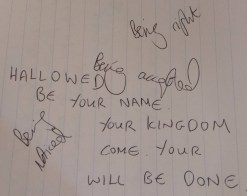
By God’s mercy and grace, carved on mine are the words: HALLOWED BE YOUR NAME, YOUR KINGDOM COME, YOUR WILL BE DONE. However, persistent bits of graffiti keep appearing. Being right, being noticed, and being accepted are all regular interlopers for me. What about you?

blog-graffi-2.jpg